Charlotte, North Carolina
I build software. I teach. I've come to think those were always the same job.
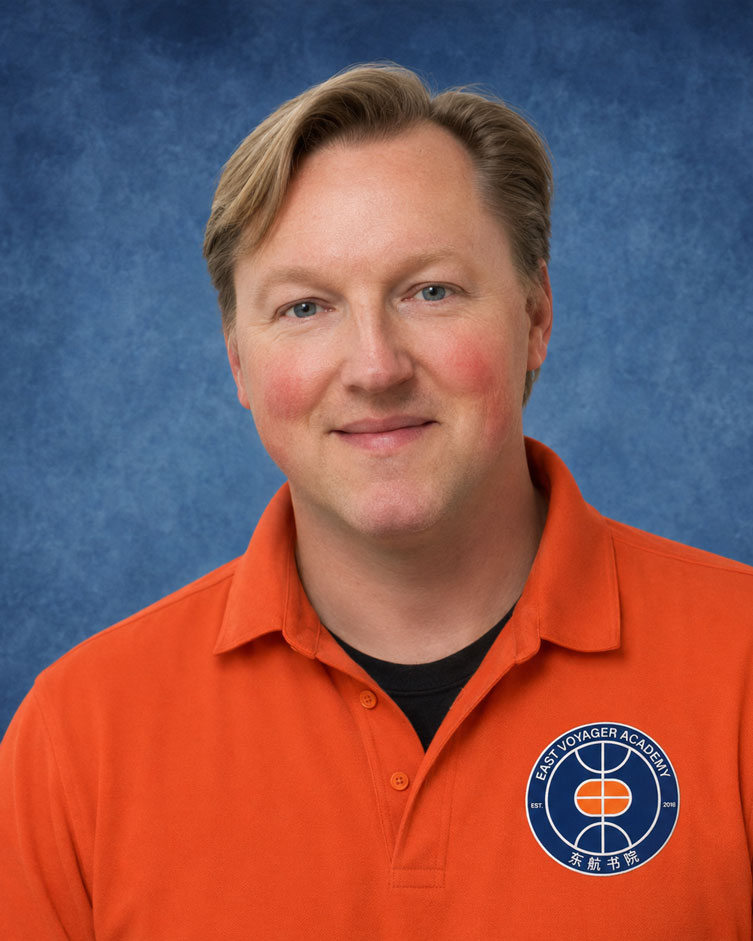
I'm Kris. Thirty years building software, a stretch as an Army medic before that, and these days I teach Middle Grades Math & Science at a K-8 Mandarin immersion charter here in Charlotte. I'm heading into my second year in the classroom, and I never put the software down. Most of my code now goes into a learning platform my wife Sue and I run through USA Web School, built for the whole education world (teachers, students, administrators, all of it), and my own students happen to be on it every single day.
So don't read the "teacher" part as a career change. Read it as another active tour of duty. Because the tools we hand people, especially kids, are either serving them or selling them, and I decided a long time ago which side I build for.
On paper it looks like three careers. Underneath, it's been one job.
I served as a Combat Medic with the 82nd Airborne, two combat tours. I earned the Combat Medical Badge twice, awarded for providing care while under enemy fire. But that was the extreme edge of the work, the worst possible day compressed into a couple of minutes. The actual job, day to day, was counsel and instruction and getting teams both small and large organized around a mission that mattered. Keeping people ready. Keeping people together.
Then came about thirty years in IT and full-stack engineering. Enterprise systems, automation that wiped out thousands of hours of somebody's manual grind, and (this part never changed) a whole lot of teaching. Four years of it formally as a corporate trainer, the rest just because I can't sit next to a coworker without trading what we each know.
Now I'm in a middle school. Different uniform, same work. Educate. Counsel. Build the tool that helps. Get people pointed at something worth doing. I've been running that same play my entire life. The classroom is just where it's happening now.
I'm also, for the record, a humanist celebrant, and I mean it. I love people. And I don't think teaching and learning are things that only happen in a building with a smartboard. They're going on constantly, in both directions, and they're a huge part of what makes us human. So fair warning: I'm going to teach a little on this page. And I'm going to back it up.
- Full-stack web systems (APIs, data models, deployments)
- Product thinking (from vague goal to shipped thing)
- UX and usability (reduce friction, increase trust)
- Community programs and volunteer operations
- Ethical tech and risk thinking (privacy, safety, incentives)
Current · 2025-present
My classroom runs on software I wrote, and it's working
Middle Grades Math & Science · K-8 Mandarin Immersion Charter · Charlotte, NC
Old habits, preferably the good ones, die hard. When I need a tool, I build it instead of buying it off a shelf. So over the last year that's turned into an eight-lesson interactive math series, a stack of self-contained HTML science lessons and labs with the diagrams built right into the page, math games with a real engine under the hood, and a full run of assessments across grades 5 through 8, all lined up against the NC DPI 2023 standards because that's the game we're handed.
But the tools aren't the point. What they're doing is. My students are using this software, and they're using it with a high degree of success. That's not a pitch, it's what I watch happen in the room. And it's the thing that convinced me the classroom isn't the ceiling of what I'm building. It's the proving ground.
I'm not going to pretend it's all figured out. First year of teaching humbles you fast, and plenty of my ideas crashed on the first run the same way software does. That's fine. That's the job. You ship, you watch it break, you fix it, you ship again. The difference now is that when it works, a kid walks away a little sharper, a little more capable, a little more ready. There's no better feedback loop than that.
Let's ask the honest question
Are we actually preparing these kids for the world they're about to walk into?
I don't think anyone can look at the numbers and say yes with a straight face. So let's look at them.
About a third of American 8th graders can't read at even a basic level. Not "below grade level," below basic. That's the worst result in the roughly three decades we've been keeping national score. Nationally, only around one in three kids hits proficient in reading at all. And by senior year, our own Secretary of Education put it plainly: close to half of high school seniors are testing below basic in math and reading, right at the moment they're about to head off into a job, the military, or college.
Now look at what's waiting for them on the other side of the diploma. Americans owe roughly $1.25 trillion on credit cards, an all-time high, and last year alone we handed the card companies around $253 billion in interest and fees. Just interest and fees. Student loan debt sits north of $1.8 trillion, spread across some 44 million people. Total household debt has climbed past $18 trillion.
I'm going to say the strong version out loud, because tiptoeing around it hasn't fixed anything. As a society, through the institutions we built and keep feeding, we've gotten very good at manufacturing consumers. We've normalized debt as a life stage and treated a paycheck-to-paycheck existence like it's just the weather. We're not accidentally producing kids who can't read closely and can't do the math on a loan. That's the output of the system as it's currently running.
So teaching them the state standards is the floor, not the goal. The real goal is turning out young people who are genuinely literate, who can think critically, who can navigate a world that is complicated on purpose and technological in ways that are designed to work on them. In 2026, doing that well isn't just good teaching. It's an act of rebellion. Let's just say it.
Technology should serve people, or it shouldn't exist
This is the idea the whole thing runs on. I call it Technology Philanthropy, and it's simpler than it sounds.
We are sitting on the most powerful set of tools humans have ever built. That's not up for debate. The only real question is what we point them at. Aim technology at human health, learning, and wellbeing, and there is almost nothing we can't do. The future gets genuinely bright. Aim it the other way, at exploiting people, controlling them, extracting from them, weaponizing attention and outrage and debt against the very people it's supposed to serve, and we're in real trouble.
That's the fork in the road, and here's the part people forget: it's a choice, not a forecast. Technology for people, for life. Not technology for machines, for profit, for its own momentum. We get to pick. But somebody has to actually pick, out loud, and then go build the thing that proves it's possible.
I write more about this at Imagine the FutureUSA Web School: proving it at scale
This is the part Sue and I are proudest of.
USA Web School is our nonprofit, and Sue is our CEO. We've been married more than fifteen years and we're in this together, all the way down. What we're building is a learning platform, an LMS, designed from the ground up on the Technology Philanthropy principle: built to serve the learner, protect their privacy, and hand real capability to teachers, instead of built to harvest kids and monetize their attention.
My classroom is where it gets tested. But the goal was never one classroom, or one school, or one city. The goal is to force-multiply what works out to as many learners as we can reach, ideally every learner in this country who could use it. I know exactly how that sounds. It's a lofty goal. It's also already happening, one lesson and one student at a time, which is the only way anything real ever gets built.
Think of it as second service. Soldiering is one way to serve your country. So is this. Teaching is boots on the ground, in the room, every single day, with the kids right in front of you. Building the platform is how you make that service reach past the walls of your own classroom. Same mission, two ranges.
- Sue Tyte, CEO & co-founder
- Kris Tyte, co-founder & platform engineer
- Married 15+ years, building this together
- A learning platform for the whole education world: teachers, students, administrators
- Built on Technology Philanthropy: serve the learner, protect their privacy
Selected work
A few public things that show how I think and what I ship.
A household inventory tool. The goal is simple: keep track of what you own, what it needs, and what it costs you over time.
Podcast exploring technology, environment, and philosophy without pretending any of this is simple.
Writing and frameworks around Technology Philanthropy and how we apply tech for the benefit of humanity.
A community grounded in a non-theistic humanist philosophy and doing good works, not just talking about them.
Operations, business, and product development for a hands-free shoe cover product.
So where are we all headed?
I don't see enough people laying down an actual vision, so I'll lay one down.
Picture a country that decided, on purpose, to graduate young people who can read anything put in front of them and know when they're being played. Who can run the numbers on a loan, a lease, a promise, and make their own call. Who are civically awake, who can hold a hard idea in their head without falling apart, and who walk out the door genuinely ready for the day they're actually going to face. Not the day the brochure promised them.
That's not pie in the sky. Every piece of it is buildable with what we already have in our hands right now. What's been missing isn't the technology or the money or the know-how. It's people willing to be courageous, to plant a flag and say we can do better, we deserve better, and then to demand it, for themselves, for their kids, for their families, for the whole society.
That's the standard I try to live by and project outward. You don't just keep these for yourself. You push them out into the world.
So people are whole enough to build.
So a good life is actually within reach, not just marketed at you.
Caring about people is easy until it costs you something. That's exactly where it starts to matter.
Because here's the cliche that's actually an understatement now. It takes a village to raise a child. In 2026, with young minds getting pulled in fifty directions by systems built to pull them, it takes a massive, deliberate, all-hands effort just to raise kids who are healthy, happy, literate, and free. It's a Herculean lift.
So what are we waiting for. Let's go.
The truth I want you to leave with
Stripped all the way down, here's what I actually believe.
When you work to make life better for the people around you, your own life gets better too. That's not a slogan, it's how we're built. Every scrap of progress worth having came from people deciding that bare survival wasn't good enough, that suffering could be cut down, that the circle of who gets a good life could be drawn wider. I want that circle drawn as wide as it will go. A fair shot at what this world has to offer, handed to as many people as possible, no matter where they started or what they were dealt.
I care about everyone's wellbeing, not just the people who look like me or agree with me. Showing up for your community is a duty. Taking care of this planet is a duty. And here's the part none of us gets to opt out of: the kind of world we live in is ours to build. Not fate's. Not somebody else's. Ours, and ours alone.
I happen to think we're capable of far more than we act like we are. This whole site is me betting on that. I'd love for you to bet on it too.
Experience
A simple timeline. If you want the formal version, the resume link up top is there.
Second year in the classroom after thirty years in tech, and I never put the software down. I still build my own curriculum and standards-aligned assessments instead of buying what's already on the shelf. Old habits die hard. See the classroom work above.
Operations, business, and product development. I like small teams when the work is real, the feedback loop is tight, and nobody is hiding behind process for the sake of it.
Building the LMS itself: a learning platform for teachers, students, and administrators, built on the Technology Philanthropy principle instead of the ad-tech one. More on USA Web School above.
Community organizing and ceremony work for weddings, memorials, and major life transitions. It is surprisingly aligned with product work: listen carefully, get the details right, and treat people with dignity.
Earned the Combat Medical Badge twice, awarded for providing care while under enemy fire. The extreme edge of the job was rare. The daily work was counsel, instruction, and keeping teams organized around a mission that mattered, which turned out to be the same job I'm still doing.
Education and learning
I treat education like a habit, not a phase. Some of it is formal, some of it is self-driven, and a lot of it is just the daily practice of building, testing, and explaining systems until they make sense.
University-level study in human-centered computing topics (social systems, design, cognition) alongside the day job. If you want specifics, ask and I will give you the clean, non-hand-wavy version.
Building products and nonprofit programs is a constant education in incentives, usability, and the quiet ways systems fail. It is also where the good ideas get stress-tested by reality.
Contact
The fastest way to reach me is email. Tell me what you are building, what is broken, and what "good" looks like. If it is a fit, I will respond quickly. If it is not, I will still be honest.